

There’s a joke I heard a long time ago, and I’ve carried it with me ever since—not because it’s funny, but because of what it means.
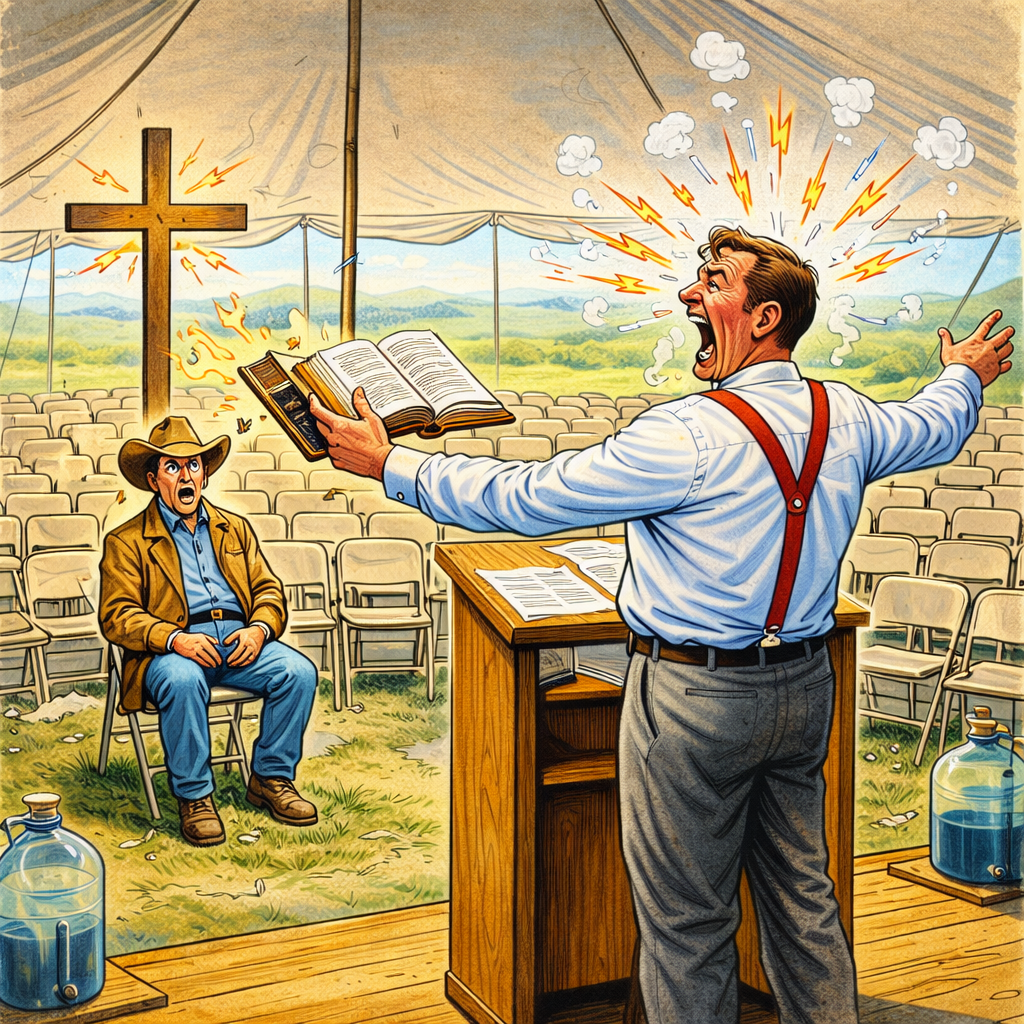
A revival preacher comes into a small Midwestern town. All week, he passes out flyers, builds his big tent, sets out more than a thousand chairs, stacks paper programs on a table so the wind won’t take them, places water jugs at every corner, and raises a large cross beside the stage.
Sunday comes. Ten o’clock hits.
Only one cowboy shows up.
The preacher waits a bit, then finally asks, “Where is everybody?”
The cowboy shrugs. “Don’t know.”
The preacher sighs. “I don’t know what I should do.”
The cowboy says, “Well, partner, if I went out to feed the cows and only one showed up…”
He pauses.
“…I’d sure feed him.”
Inspired by the wisdom, the preacher steps to the pulpit and begins preaching as he has never preached before.
He talks about the fall and the blessings. His voice trembles as he speaks of forgiveness and sacrifice. Then he rises into a thunder about accountability. He cries over loss. He nearly leaps with excitement when he reaches glory.
When it’s finally over, he comes down and asks the cowboy, “How did you like the service?”
The cowboy nods and says, “Well, I said I’d feed the cow, not bury him in the food.”
I remember that joke not because it makes me laugh, but because it has meaning for me throughout my life.
Years ago, when I owned my business, the police department came by asking local businesses for donations. We gave, and in return, they handed us tickets to a concert featuring The Tokens, best known for The Lion Sleeps Tonight.
This was around the time The Lion King had come out a year or two earlier, so the song was having another moment.
I almost didn’t go. Even though I’m not exactly young anymore, The Tokens still predated me by quite a bit. But it would be a nice night out with my wife.
We arrived early and sat in the third row, center seats. Hardly anyone else was there—maybe one other couple. As showtime got closer, the crowd never really grew. Twenty people at most.
The venue, though small, could have held two or three thousand.
Then they came out and performed as if it were a packed stadium.
I remember that no one sat in the first two rows in front of us. The horn player ran across the stage, switching between two horns and sometimes playing both at once, performing with incredible energy. These men, whose careers began in the 1950s, are probably in their seventies and giving their all. At one point during the show, they exchanged instruments.
The singer told stories about songwriting and the members they had lost over the years.
It was a great experience. True professionals.
Many years later, I held an event and hired a local band. They didn’t want to start because not enough people had shown up.
That really disturbed me.
Here was a local group with no records, no history, no number-one hit, hesitating to play for the people who did come.
Meanwhile, I had watched seasoned professionals give everything they had to a room with fewer than twenty people.
The lesson seems simple.
Teachers instruct those present. Servers attend to each individual customer entering your store.
Entertainers perform for the single person who arrives. I write for whoever the reader may be.
Sometimes the size of the audience matters far less than the sincerity of the offering.
 Albert Alarcon Jr. | Author
Leave a comment