

Why the Things We Give to Others Matter More Than We Think
How much of the world we experience is shaped by what we contribute to it?
I don’t mean that in the simplistic sense that positive thinking magically fixes everything. Life doesn’t work like that. Some days are painful. Some people carry enormous burdens. There are injustices, losses, disappointments, and moments when kindness feels very far away.
What I mean is something quieter and more human.
Every interaction leaves something behind. A little more bitterness or a little more compassion. A little more patience or a little more frustration. Even small moments matter more than we realize. A conversation. A glance. The tone we use with someone who may already be struggling.
I remember hearing a comedian once tell a story about this idea in a funny way, but also in a surprisingly insightful way.
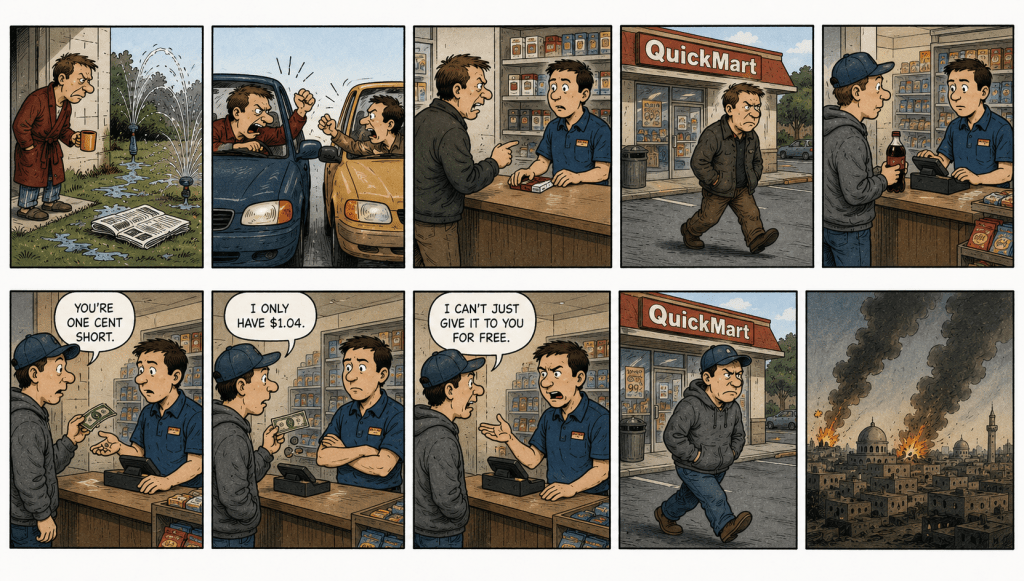
A man wakes up in the morning and walks outside to get his newspaper. But the sprinklers had already gone off, and now the newspaper is soaked in the middle of the lawn. Frustrated, he grabs it, throws it against the door, gets in his car, and drives away, angry.
A few minutes later, still irritated about the newspaper, he cuts another driver off in traffic. Horns are exchanged. Angry gestures follow. Then the first driver speeds away.
But now the second driver is upset.
That second driver eventually stops at a convenience store and asks for a pack of cigarettes. The cashier reaches behind the counter and puts the wrong pack down. Already irritated from the traffic incident, the customer snaps back, insisting he asked for a different kind. The cashier becomes defensive. Tension rises. The customer leaves irritated.
Now the cashier is upset.
A few minutes later, another customer walks in carrying a soda to the counter. The cashier rings it up.
“You’re one cent short.”
The customer explains he only has $1.04. The cashier refuses to let it slide. The customer leaves frustrated.
And according to the comedian, by the end of the day, all of this eventually affects the Middle East.
So much of human tension spreads this way. One frustrated moment becomes another. One person passes bitterness into the next interaction, and that person carries it into another one after that. Eventually, nobody even remembers where the original frustration began. They only experience the emotional weight being passed from person to person.
And the opposite is probably true, too. Patience spreads. Kindness spreads. Calmness spreads. Sometimes, one small act of understanding interrupts an entire chain reaction that would otherwise continue.
Over time, those moments become part of the emotional atmosphere we all live inside. The older I get, the more I think this has less to do with self-help and more to do with emotional responsibility.
We spend so much time wanting the world to improve. We want people to be kinder, more understanding, more patient, more compassionate. But when we really think about it, the only person any of us truly control is ourselves. I cannot force peace into another person. I cannot demand compassion from the world. The only thing I can fully choose is what I bring into the room when I enter it. And maybe that matters more than we think.
I’ve noticed that people who constantly take emotional energy from others are often not doing very well themselves. People who spread anger usually carry anger. People who constantly seek reassurance are often starving for reassurance internally. Hurt people often reach outward, trying to quiet something unsettled inside themselves.
That does not make harmful behavior acceptable. But it does remind me that many difficult people are not simply cruel. Sometimes they are exhausted, lonely, frightened, resentful, or emotionally lost. And because of that, I think we have to be careful about what we pass forward.
If someone gives me bitterness and I hand bitterness to the next person, then I become part of the chain. I may feel justified, but I am still contributing to the very atmosphere I claim to dislike.
That part is difficult.
It is easy to be kind when we feel good. It is much harder when we feel ignored, frustrated, disappointed, or emotionally drained. Yet those moments are often when our choices matter most, because what we consistently give to the world eventually becomes part of how other people experience it.
I do not want to live in a world where cruelty, hostility, and emotional exhaustion dominate every interaction. I do not want to contribute to a culture where people feel constantly attacked, dismissed, or devalued. And if I truly believe that, then I have some responsibility in shaping the emotional environment around me. Not perfectly. Not endlessly. Not in a way that ignores suffering or pretends difficult things do not exist. But intentionally.
I think people are remembered less for what they took from the world and more for what they gave back to it. Not wealth or status, but emotional presence. The feeling they left behind in other people. Some people leave others feeling smaller. Some leave others feeling safer.
And maybe most of us underestimate how much we affect one another. A little patience travels farther than we think. So does bitterness.
The only way to create a more compassionate world is to contribute compassion to it ourselves.
Albert Jr
Author of The Nature Within Us
 Albert Alarcon Jr. | Author
Leave a comment