

Compassion, judgment, and the shades between good and bad
One of my earliest memories is of my mom slapping my hand and saying, “That’s bad.” She was trying to teach a small child the difference between right and wrong, danger and safety, what is acceptable and what is not.
When we are young, we are often taught life as a kind of dichotomy: black or white, good or evil, right or wrong. And of course, sometimes those categories matter. Sometimes there really is a better choice and a worse choice. Sometimes something is kind, and sometimes something is cruel. Sometimes something is honest; sometimes it is a lie. But if we are not careful, this way of thinking can become too simple. It can turn into what logic calls a false dichotomy: the idea that there are only two choices when, in truth, there may be many.
Later in life, we hear another version of the same mistake. We hear that everything comes in threes: three kinds of people, three stages of life, three kinds of love, three paths, three lessons. Three can feel wiser than two because it gives us one more option. But it is still a box. It is still a way of saying, “Here are the categories. Choose one.” But life does not really come in only twos, and it does not come in only threes. People do not fit that neatly. Love does not fit that neatly. Courage, kindness, selfishness, fear, goodness — none of these things fit perfectly into a little box.
I think I first understood this as a painter.
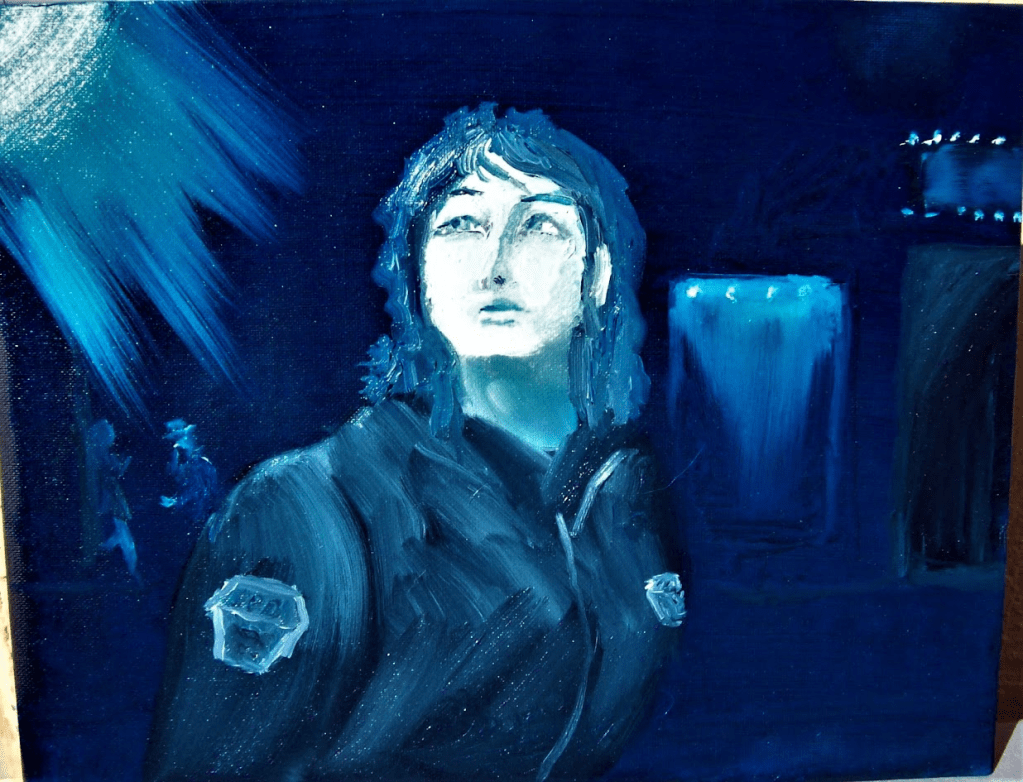
I once painted a picture using only blue and white. At first, that sounds like a limitation. Two colors. Two choices. Blue or white. But that was not what happened. Between those two colors, there were shadows. There were reflections. There was softness, distance, depth, and light. There were places where the blue became almost black, and places where the white became almost silver. The painting did not become simple because I limited the colors. In some ways, it became more complex. And I think human beings are like that too.
We are often taught to think in opposites: good or bad, strong or weak, kind or selfish, brave or afraid. But most human beings do not live at the ends of those opposites. We live somewhere in the shades between them. A person can be kind in one moment and selfish in another. A person can be brave and still afraid. A person can tell the truth and still be cruel. A person can stay quiet and still be merciful. That is why I prefer the idea of a map to a judgment box.
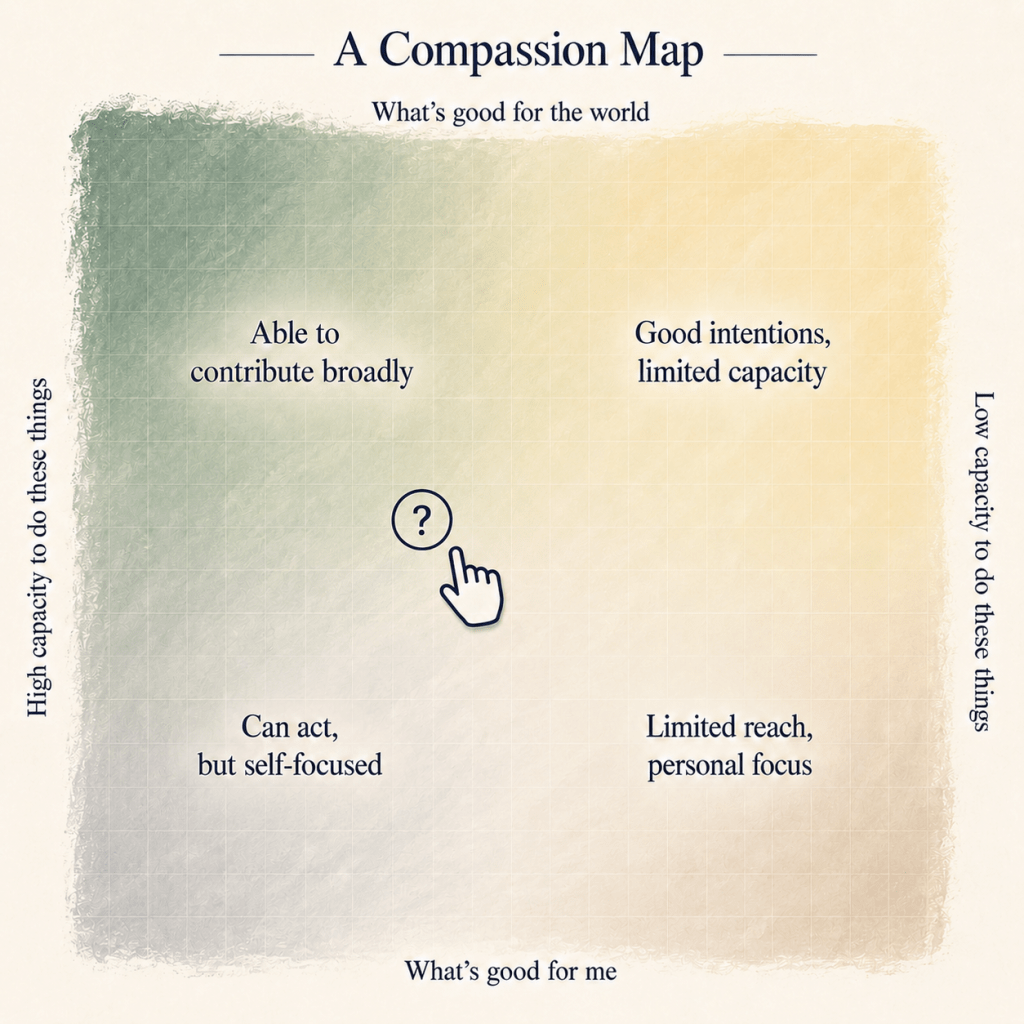
The Compassion Map is not meant to sort people into permanent categories. It is not meant to say, “This person belongs here, and that person belongs there.” It is meant to help us think. At the top is what is good for the world. At the bottom is what is good for me. On one side is a high capacity to act. On the other side is a low capacity to act. And between those points, there are many shades.
The question mark matters because most of the time, we do not really know where a person belongs on the map. We are guessing from the outside.
Someone may have a great capacity to help, but use that ability mostly for themselves. Someone else may care deeply about the world but not have much power, money, health, time, or influence. Another person may be able to contribute broadly. Another may be able to love only a few people close to them. That does not make one person purely good and another person purely bad. It gives us a more honest way to look.
Because sometimes selfishness is cruelty. But sometimes selfishness is exhaustion. Sometimes a person does not help because they do not care. But sometimes they do not help because they are barely holding themselves together. Those are not the same thing. And sometimes people with great ability do very little good. They have talent, money, intelligence, strength, or influence, but they use most of it only to protect themselves. That is not the same as someone who has very little ability but still tries to be decent.
The map does not erase right and wrong. It does not say that everything is equal. It does not say that harm is harmless or that cruelty should be excused. It simply asks us to look more carefully. A false dichotomy makes life easier to judge, but harder to understand. The world becomes simpler when we say, “That person is good,” or “That person is bad.” But it also becomes less true. Human beings are not usually pure colors. We are mixtures. We are gradients. We are movements. We are people becoming something, losing something, recovering something, hiding something, or trying again.
A brave act can contain fear. A loving choice can still hurt. A good person can fail. A bad moment does not always make a bad life. That is where compassion begins. Not when we stop caring about right and wrong, but when we stop pretending that every soul can be sorted into only two boxes.
Maybe goodness is not a switch. Maybe it is more like a color chart. Maybe the question is not only, “Is this person good or bad?” Maybe the better question is: Where are they standing? What are they capable of? Who are they serving? What are they carrying? And which direction are they moving?
Because even with only two colors, a painter can make a world of shades. And even inside one human life, there may be more shades than we first know how to see.
Albert Jr
Author of The Nature Within Us
 Albert Alarcon Jr.
Leave a comment