

“All the world’s a stage, and all the men and women merely players.”
“Know thyself.”
“In a world where you can be anything, be yourself.”
These are famous sayings, and there is truth in them. But if we do not stop and think about them, they can become just another set of pleasant words. They sound wise, but they do not ask much from us.
I believe in freedom. But there are many kinds of freedom.
There is freedom from sickness. Freedom from fear. Freedom to speak. Freedom to spend. Freedom to move. Freedom to control ourselves.
But today I am thinking about a different kind of freedom: the freedom to be ourselves.
That sounds simple, but it is not.
I have seen people laugh at jokes they did not think were funny, agree with opinions they did not really hold, and stay quiet when something inside them wanted to object. Not because they were dishonest people, but because belonging has a way of asking for small payments. A laugh here. A silence there. A little compromise. And after a while, we may not notice how much of ourselves we have handed over.
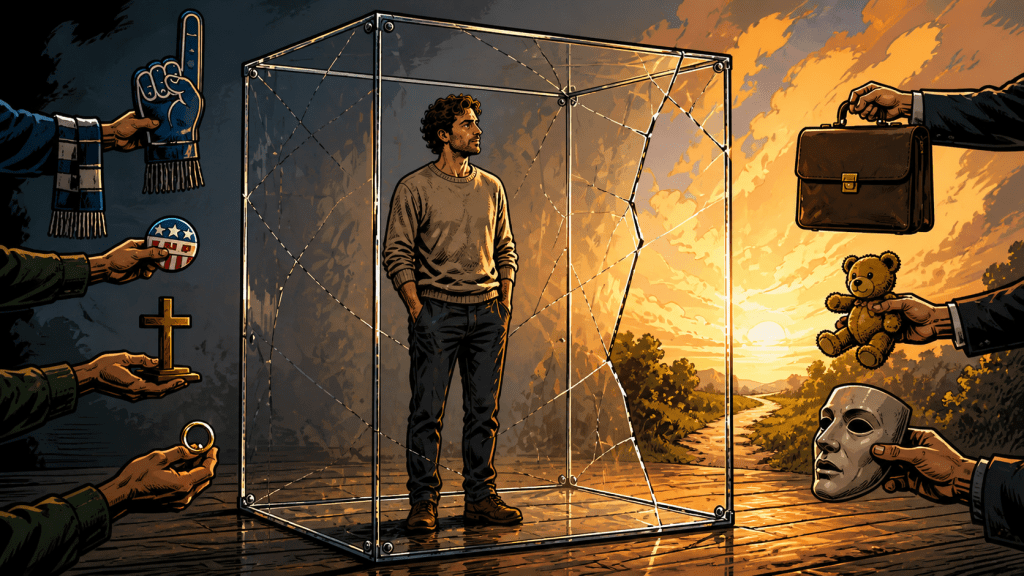
We identify ourselves by many things. We say we are parents, husbands, wives, Raider fans, Cowboy fans, Democrats, Republicans, Christians, Muslims, Buddhists, and many other things. At first, these may sound like simple descriptions. But they are not all the same.
Some are roles. Some are beliefs. Some are loyalties. Some are groups we join. Some are identities we inherit. Some are identities we choose. And once we accept them, we often accept more than the name itself.
We accept what comes with it.
We might start out simply liking a sports team. But over time, that team can become part of who we are. We wear the shirt. We argue with rival fans. We feel insulted when the team is insulted. In the past, maybe people mostly rooted for the home team because that was what was nearby. But now we can watch almost any team from almost anywhere. We can choose who to follow. We can choose what group to belong to.
That is not always bad. Belonging can be fun. It can give us connection. It can give us something to share with other people.
But belonging can also ask something from us.
Sometimes we begin accepting ideas that are not really ours just because they come with the group.
This happens in politics. It happens in religion. It happens in families. It happens in friendships. It happens anywhere people build an identity around belonging.
In politics, we may find ourselves defending something we do not really believe simply because someone from the other side accused us of believing it. We may argue harder than we mean to, not because the idea belongs to us, but because the accusation does. Instead of stopping and saying, “Actually, that is not what I believe,” we step into the role that has been handed to us.
We defend the box.
And often, we did not even build the box.
That is where identity becomes dangerous. Not because identity itself is bad, but because we can forget that we are allowed to think.
We are allowed to step back.
We are allowed to say, “That part does not belong to me.”
There is a difference between a role and an identity. Being a parent, husband, or wife is a role, and these roles come with real responsibilities. We may choose how to live them, but we cannot always pretend they have no weight.
Still, even real roles come with rules that are not always real. We can be traditional parents or different kinds of parents. We can be traditional husbands or wives, or we can shape those roles in ways that work for our lives. Many of the rules around these roles are customs, expectations, and stories people repeat until they feel like laws.
And sometimes they are not laws at all.
They are just boxes.
Tattoos can work the same way. For some of us, a tattoo may express something real about how we see ourselves. For others, it may begin with a group of friends saying, “Let’s all get one.” Maybe only one person really wanted it, but everyone went along.
That may seem harmless. Sometimes it is. But it also shows how easy it is to become someone slightly less like ourselves just to stay connected to others.
We loosen our standards. We adjust our beliefs. We make ourselves fit.
And after a while, we may not even notice we are doing it.
And I do not say this as if it is easy. Belonging is one of the deepest human needs we have. We want to be welcomed. We want to be understood. We want to sit at the table without having to explain ourselves every five minutes. So it makes sense that we sometimes bend. The danger is not bending once in a while. The danger is forgetting that we bent.
That is why knowing ourselves matters.
There was a politician who once said that in a world where we learn to expect less from the world, the sad part is that we may start expecting less from ourselves. I think that is true. When we lower our standards just to belong, we do not only expect less from others. We expect less from our own conscience.
We let the group think for us.
We let the label speak for us.
We let the argument decide what we believe before we have even asked ourselves the question.
But we do not have to do that.
We are not only sports fans. We are not only political parties. We are not only religions. We are not only the roles someone else expects us to play.
We may be fathers, mothers, husbands, wives, friends, believers, skeptics, citizens, fans, or members of some group. But none of those things should take away our responsibility to think honestly.
We do not have to argue for things we do not believe.
We do not have to defend every idea that comes with our side.
We do not have to accept every rule that comes with our role.
And we do not have to live inside the box someone else built for us.
The world may still try to put us there. Family, friends, parties, churches, teams, and traditions may all hand us boxes to stand in. They may tell us what we must believe if we belong to this group, or what we must reject if we belong to another.
But the freedom to be ourselves begins when we can say:
That part is not mine.
I do not believe that.
I do not have to defend that.
I can belong without surrendering my conscience.
We should not defend what we do not really believe just because we accepted a label.
Maybe that is what “be yourself” really means. Not doing whatever we want. Not pretending we are free from responsibility. Not standing alone just to prove we cannot be influenced by anyone.
Most of us cannot live that way, and maybe we are not meant to. We need families, friends, communities, traditions, and shared loyalties. But we also need enough honesty inside ourselves to know where belonging ends and surrender begins.
Because the goal is not to have no identity.
The goal is to have one that still leaves room for our conscience.
And maybe, in the end, the only person we can truly be best at being is ourselves.
Albert Jr
Author of The Nature Within Us
 Albert Alarcon Jr. | Author
Leave a comment