

If you know me, you know I enjoy pop culture, especially science fiction. I do not watch it only for entertainment. I watch it because science fiction often carries questions we are not ready to ask directly.
Two stories keep getting me thinking.
One is The Obsolete Man, about a librarian in a future where books and libraries are no longer needed. Because his work no longer serves a purpose, the state decides he does not either. He is not sentenced to death for violence or rebellion. He is sentenced for irrelevance.
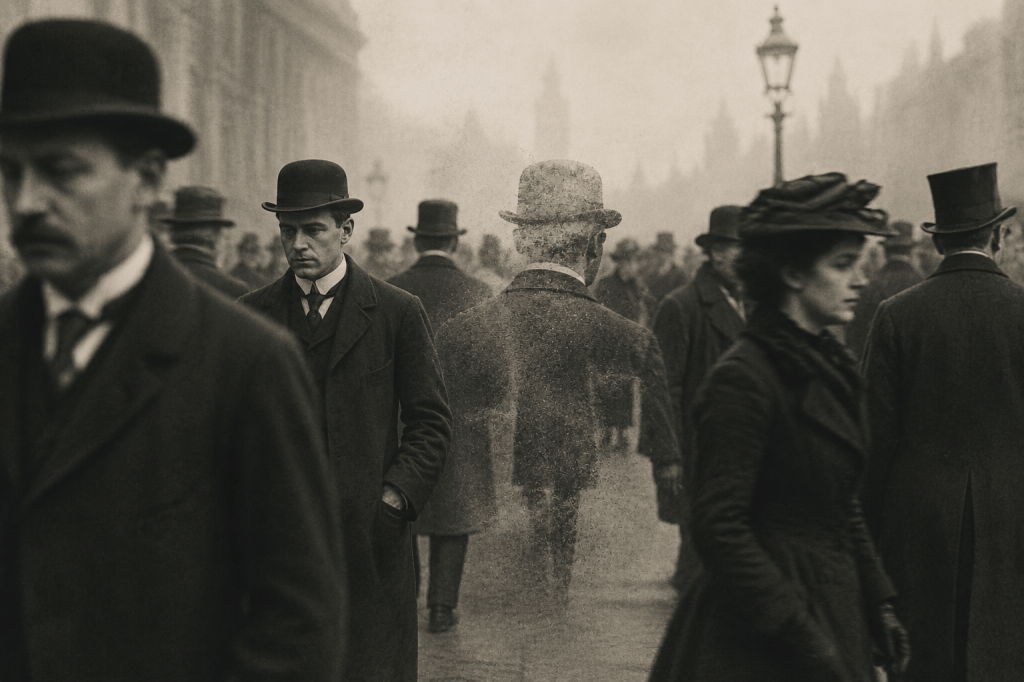
The other is To See the Invisible Man, about a man who does not fit well into society and is punished with invisibility. A mark is placed on his forehead, and everyone else is required to ignore him. He is still present, still alive, but no longer socially real.
These stories are usually read as warnings about government overreach, and that is certainly part of them. But I think they are asking something more uncomfortable.
Who really decides who disappears?
In the stories, the government decides. In real life, it is often society.
When society decides you are no longer valuable, it does not announce it. It simply stops noticing you. Stops listening. Stops responding.
Today, this often happens through attention. We live in a culture where whatever bleeds leads. Outrage spreads. Cruelty performs. Normal people do not trend. Quiet kindness does not travel well. So we slowly end up creating the very thing we claim to dislike. We reinforce bad behavior by rewarding it with attention, and we weaken good behavior by ignoring it.
The system itself is not good or evil. It simply reflects where attention goes. Over time, people stop being treated as people and start being treated as background noise.
Which raises a harder question.
Is invisibility something we impose, or something we quietly prefer?
When does suffering become background?
This is easiest to see in the context of homelessness. When suffering is rare, it interrupts us. We ask what happened. We wonder what we owe. But when it becomes widespread, something changes. Not because we stop caring, but because caring starts to feel impossible.
When suffering becomes constant, unresolved, and everywhere, people protect themselves. Human beings stop being encountered as individuals and start being experienced as part of the scenery, like traffic or weather. Not because we believe they do not matter, but because most people cannot carry that much visible suffering every day and still emotionally function.
So people are moved, relocated, pushed out of sight — not always as punishment, but often as relief.
And when improvement feels unlikely, and solutions feel unrealistic, expectations slowly disappear. Once expectations disappear, morality begins to lose its urgency.
Which leads to a question we rarely ask.
Are we trying to solve the problem, or are we trying not to see it?
But the most unsettling part of these stories does not stay outside us. It moves inward.
When people are ignored long enough, many begin to make themselves invisible. Not all at once. Not dramatically. Gradually, almost politely.
“I will not bother anyone.”
“They are busy.”
“I will wait.”
“It is not worth explaining.”

That is what makes it dangerous. It does not sound like erasure. It sounds like consideration. It sounds polite.
We do not decide to disappear. We adjust.
After enough moments of speaking into silence, of asking and being redirected, of being treated like a problem instead of a person, something inside us begins conserving energy. Visibility starts to feel expensive. Hope starts to feel inefficient.
So we adapt.
We speak less, not because we have nothing to say, but because we no longer expect a response. We ask less, not because we do not care, but because asking has stopped leading anywhere. We hope less because hope keeps running into walls.
Over time, the body remembers this. The hesitation before speaking. The tightening in the chest. The impulse to stay quiet even when something matters.
Eventually, something crucial changes.
We stop preparing to be heard.
We no longer imagine what someone might say back. We no longer wonder whether they will understand. We stop thinking through our response because the conversation never begins.
It ends before it starts.
When does being unseen become being obsolete?
It happens when dignity slowly shrinks from the inside.
And the lie that makes this painless is a gentle one.
“It is fine. I do not need that much.”
It sounds like maturity. It feels like realism. It passes for humility.
But sometimes it is really resignation dressed as virtue.
At that point, we do not need society to erase us. We do not need governments, systems, or algorithms.
We have already stepped out of view.
So what do you do if you notice yourself disappearing?
We need to find our voice.
But what does finding your voice actually mean?
The answer is not becoming louder, angrier, or more extreme. That only feeds the same systems that reward outrage and brutality.
Finding your voice does not mean demanding attention. It means refusing to surrender it quietly.
It means speaking one more time than feels comfortable. Asking even when you expect silence. Allowing yourself to take up a small, honest amount of space.
Not to dominate. Just to remain present.
Because recognition is a moral act. And sometimes the first recognition has to come from ourselves.
If we want to notice the people we pass by, we also have to notice the moments when we make ourselves smaller. The moments when we decide it is easier not to speak, easier not to hope, easier not to be seen.
Invisibility does not begin with cruelty.
It begins with exhaustion.
And once exhaustion begins to feel normal, obsolescence no longer needs to be enforced.
It just happens.
That is why The Obsolete Man and To See the Invisible Man still matter. They do not give us answers. They warn us about losing the question.
And maybe the most important question is this:
If being seen is part of dignity, what happens when we stop expecting it, and what happens when we decide we no longer deserve it?
Albert Jr
Author of The Nature Within Us
 Albert Alarcon Jr. | Author
Leave a comment