

I have a sister-in-law with a severe intellectual disability. She can speak and may understand some of what is being said around her, but when she talks, the words often come out as disconnected phrases. They do not form thoughts the way ours do. She also has outbursts. She may shout suddenly, scream, or do something else that draws attention.
That is simply part of loving her.
So when we take her out to eat, we try to be thoughtful. We usually ask for a table in the back, or in a side room if the restaurant has one. Not because we are ashamed of her, and not because we want to hide her away, but because we know how people are. We know the looks. We know the discomfort. We know that some people hear a loud voice or see unusual behavior and assume rudeness before they ever consider that something else may be going on.
One morning, we took her out to breakfast.
As usual, there were moments. A sudden shout. A burst of noise. The kind of thing that makes other people glance over from their pancakes and coffee. We tried to keep things calm. We did what families do. We stayed patient. We kept eating. We kept loving her in public, the way families sometimes have to, while the rest of the room decided what it thought.
When breakfast was over, we asked for the check.
The waiter told us someone had already paid for our meal.
He also said they did not want us to know who they were.
That makes me think.
Not because breakfast was expensive. Not because somebody saved us money. But because in a room where people could have chosen annoyance, one person chose mercy. One person saw us, or at least saw enough, and responded with kindness.
And that was not the only time.
Another day, we were out for lunch with family for a small birthday gathering for my wife. There were around eight or ten of us. It should have been simple, but right from the beginning, there was friction. The management was short with us. They asked why we had not called ahead. We said we had. We had left a message. Then came the strange reply that we should have called back again. As if leaving a message was not calling. As if we were somehow supposed to know we had to keep chasing them down.
It put a cloud over the table.
You know how that goes. Everyone is trying to have a good time, but now there is that feeling in the air. That embarrassment. That irritation. That sense that maybe you are being treated like a problem before you have even sat down and eaten.
And then, after the meal, the same thing happened.
Someone had paid for it.
Again, we were not told who. Again, the person wanted no recognition. It was just done quietly and left there for us to discover.
So I have seen this more than once in my own life. I have seen strangers choose kindness when it would have been easier to choose judgment, indifference, or irritation.
And I have also seen the opposite side of this conversation.
A friend of mine on social media once posted a picture of someone taking a selfie while giving money to someone in need. My friend was criticizing him for it. His point was that if you stop to photograph yourself being generous, you might not really be being generous at all. Maybe you are performing. Maybe you want applause more than you want to help.
I understand that criticism.
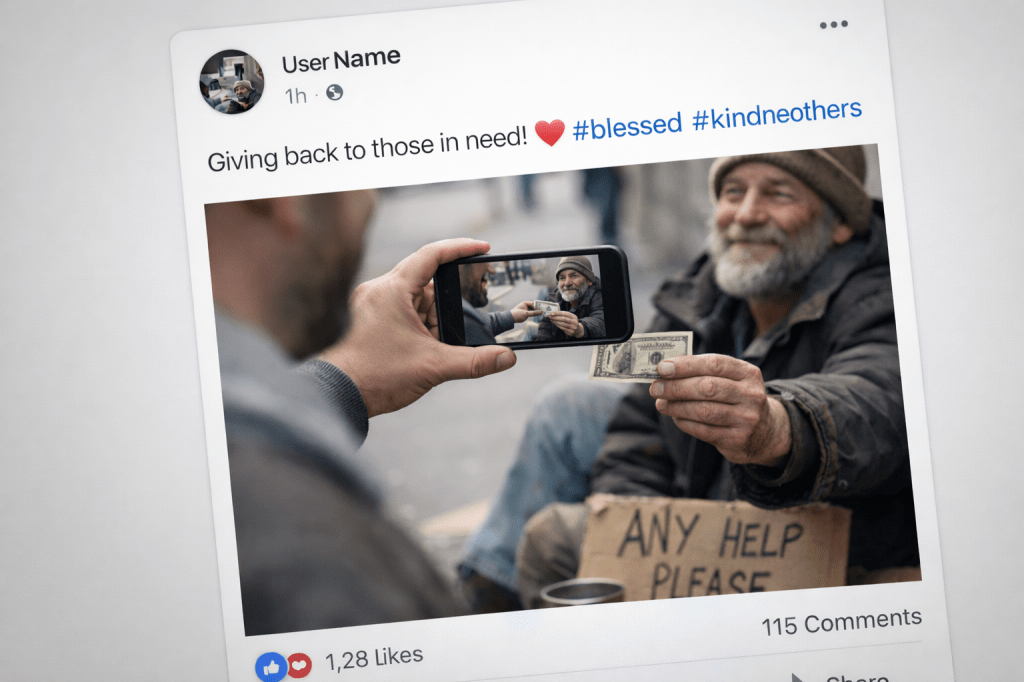
There is something beautiful about anonymous kindness. There is something humble about doing good and disappearing. No credit. No praise. No reward. Just kindness for its own sake.
But I think we stop too soon when we say that is the better way.
Because human beings do not only live by their private conscience. We also live by example.
We learn from what we see.
If all we see in the world is cruelty, selfishness, mockery, and impatience, then those things begin to look normal. They begin to feel like the common language of human life. People start to believe that this is just how the world works. This is what people do. This is what people are.
But when kindness is visible, it teaches.
When we see someone help, we are reminded that helping is possible. When we see someone show patience, we are reminded that patience is normal. When we see someone be generous, we are reminded that generosity belongs in the world and not just in sermons, sayings, and greeting cards.
Seeing kindness gives other people permission to be kind.
That matters.
In fact, I think it matters a great deal.
I am grateful for the people who paid for our meals and asked to remain unknown. Their humility is beautiful. Their kindness was real. But I also think something is lost when all kindness stays hidden. If every good deed disappears into secrecy, then the public square is left to be filled by the loudest ugliness. Cruelty becomes what we notice. Indifference becomes what we expect. And then people begin to copy that instead.
We should not only practice kindness. We should let kindness be seen.
Not because we need trophies. Not because every good deed deserves a spotlight. Not because people should turn suffering into a stage for themselves.
But because visible kindness shapes the culture around us.
It tells the nervous person at the next table that compassion is still alive.
It tells the child watching that kindness is what grown people do.
It tells the embarrassed family carrying a difficult burden that they are not alone.
It tells the rest of us that mercy is not rare, strange, or weak. It is human.
So no, I do not think the highest good is always to hide every act of love.
Sometimes the world needs to see it.
Sometimes people need to witness kindness in action to believe in it again.
And that is where I have landed:
I do not care what motivates people to be kind, as long as they are being kind.
If someone helps quietly, I am grateful.
If someone helps publicly, I am grateful.
If someone is moved by faith, by empathy, by conscience, by guilt, by love, or even by the simple human desire to be seen as good, I am still grateful if the act itself relieves pain, restores dignity, or makes life softer for someone else.
Because kindness does more than help the person in front of us.
Kindness teaches.
Kindness spreads.
Kindness, when it is visible, gives other people a model to follow. Quite kindness does not do that in the same way.
And in a world where unkindness is constantly on display, maybe one of the best things we can do is stop hiding every good thing we do.
Maybe we should let the world see compassion often enough that it starts to look normal again.
Albert Alarcon Jr.
Author of The Nature Within Us: A Journey Through Love, Reason, and What Makes Us Human
Monarch Butterflies: A Short Fable
This gentle fable follows two monarch butterflies who approach life…

 Albert Alarcon Jr.